(A 2025 snapshot of a planet at record heat, with global warming now driving health crises, rising seas, and political urgency before COP30.)
“We are hurtling toward climate chaos.”
The State of the Climate 2025
In October 2025, the American Institute of Biological Sciences published the 2025 State of the Climate Report . The report presents the stark warning that 2024 was likely to be hotter than any time in 125,000 years. Twenty-two of 34 planetary vital signs are at record levels, including ocean heat, ice loss, and greenhouse gas concentrations. Wildfire-related tree loss surged by 370%, and both Greenland and Antarctica may have passed tipping points, committing the world to meters of sea-level rise. The authors describe a state of “ecological overshoot”: population, livestock, and consumption at record highs while fossil-fuel use continues to rise. They call for urgent systems change linking policy, equity, and grassroots action to avoid a “hothouse Earth” scenario. Climate-related disasters are already costing lives and trillions of dollars — floods in Texas alone killed over 135 people in 2025, while wildfires in California caused damages exceeding US$250 billion.
Drivers of Accelerating Warming
Nearly all the warming since pre-industrial times — 1.22 °C of a 1.24 °C total — is caused by human activity. Greenhouse gas emissions averaged 53.6 gigatonnes of CO₂-equivalent per year between 2014 and 2023, mainly from fossil fuels. CO₂, methane, and nitrous oxide all reached record levels in 2024. The Earth’s energy imbalance — the gap between solar energy absorbed and released — is growing faster than expected, driving intensified heatwaves, droughts, and storms. And despite a modest slowdown in emission growth, warming continues to accelerate.
The World Meteorological Organization’s 2025 bulletin reports CO₂ concentrations reaching a record 423.9 ppm in 2024 — a 3.5 ppm increase, the largest since modern measurements began in 1957. CO₂ growth rates have tripled since the 1960s, driven by fossil fuel combustion, wildfire emissions, and the weakening the natural systems that absorb carbon from human activity. During 2024’s extreme El Niño, land and ocean absorption of CO₂ declined sharply, contributing to the record spike. Methane and nitrous oxide also hit record highs, reflecting the collapse of natural stabilizing systems. The WMO warns that failing carbon sinks will amplify warming and calls for expanded global monitoring and immediate emission cuts.
The Climate Change Tracker website collects data from a wide range of respected scientific organizations, including the Intergovernmental Panel on Climate Change (IPCC), NASA and others. The site has a section showing human-caused greenhouse gas emissions since 1850. This data corresponds closely with global temperature observations.
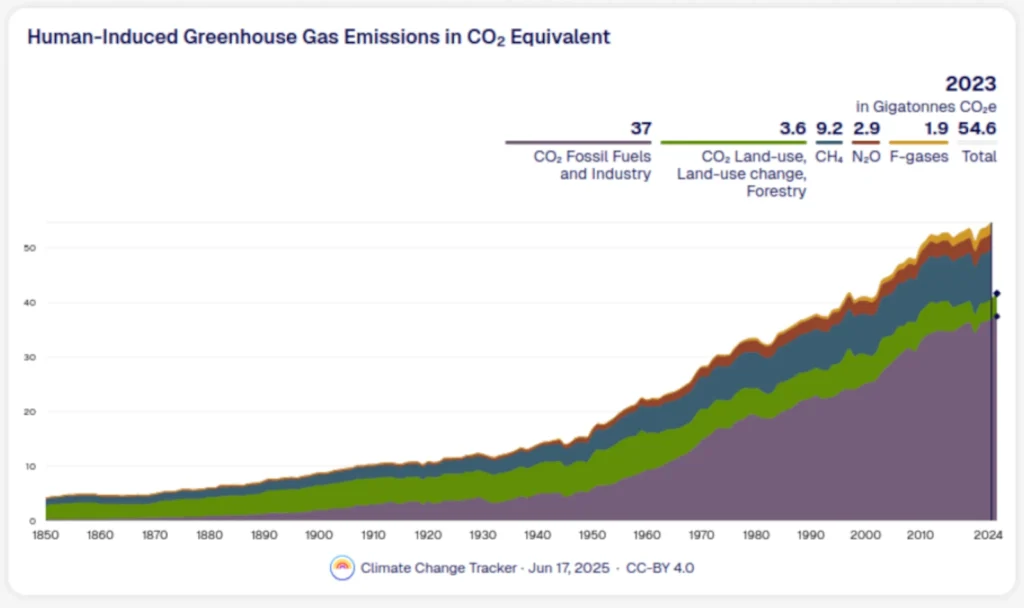
Despite optimistic news about the huge increases in renewable energy, emissions continue to rise after a brief dip during the COVID pandemic in 2020.
An overheating planet
According to Climate Change Tracker, human-induced-and-observed-global-warming), the past decade was 0.31 °C hotter than the previous one, with the rate of warming increasing to 0.27 °C per decade — the fastest in recorded history.
The Paris Agreement — the international treaty to limit global warming agreed in 2015 — set a target of limiting the temperature increase to 1.5 °C. This will probably be breached around 2030, with a figure of 2°C expected around 2048, unless emissions decline sharply. Natural variability, including El Niño and a warm North Atlantic, boosted 2024’s heat, but these extremes are now the “new normal.” Until fossil-fuel and deforestation emissions reach net zero, the upward trend will continue.
Rising Seas
Sea levels tell a similar story. The Yearly Global Mean Sea Level Rise Report shows a rise of 22.8 cm since 1901, with the pace accelerating to 4.5 cm from 2014–2024 — more than double the 20th-century average. Expansion of seawater as it heats up, together with melting ice sheets, are the forces driving this increase, threatening 680 million people in low-lying areas with flooding, erosion, and storm surges. Even if emissions fall, deep-ocean warming and continued ice-sheet melt will ensure further acceleration for many years to come.
The Human Cost of a Warming World
Besides the death and destruction caused by climate disasters, the heat and smoke from greenhouse gases have significant health effects. The Lancet Countdown links climate inaction directly to surging health crises. Heat-related deaths are up 23% since the 1990s, now totaling 546,000 annually. Wildfire smoke caused 154,000 deaths in 2024, while fossil-fuel air pollution kills 2.5 million people every year.
The science is unequivocal: humanity has entered dangerous territory, and things will only get worse until we have a fundamental change in the way we live. The 2025 State of the Climate Report and other leading analyses point to the same solutions — ending fossil fuel dependency, protecting and restoring forests, and shifting to plant-rich diets. The longer governments cling to fossil-fuel economies, the greater will be the human toll, for us and for future generations.
The urgency of COP30
As the world approaches COP30 in Belém, Brazil (November 2025), global attention is turning toward new Nationally Determined Contributions (NDCs) under the Paris Agreement. The conference aims to accelerate the phaseout of fossil fuels, expand climate finance for developing nations, and finalize frameworks for adaptation and loss-and-damage funding. COP30 is supposed to reinforce accountability and strengthen commitments to the 1.5 °C target. As we now know, the 1.5 ° target can be thrown out the window. And going on past history, the prospect of a reset of individual country plans is not promising.